A guide for home stagers
Holdover fees: how to bill the months a house sits.
Every stager has a house that didn't sell in the first month. The furniture is still working, the staging fee has run out, and the extra months are easy to forget to bill. Here's how to set holdover up so it's clear to the client and gets paid without you chasing it.
Try StageEngine free for 14 daysNo credit card.

What a holdover fee is
Your staging fee covers a term, often the first 30 to 90 days the house is on the market. If the furniture is still in the house when that term ends, the client keeps paying for it: that's the holdover (some stagers call it an extension fee or a monthly rental). It's usually billed for each extra month, or each extra 30 days, until you de-stage.

Holdover isn't a penalty. Your pieces are out of the warehouse and can't go on another job, so the fee pays for that. Saying it that plainly up front is most of what keeps holdover from turning into an awkward conversation later.
Two common ways to set the amount
A flat monthly amount
One number per month after the term. Easy for the client and the agent to understand, and easy to quote on the phone.
A percent of the staging fee
Each extra month costs a set percent of the original fee, so a big house pays more than a small one without you pricing every job twice.
Monthly or every 30 days
Decide whether you bill by calendar month or by each 30 days past the term, and say which in writing. Both work; mixing them up is what causes disputes.
The de-stage fee is separate
If you charge to pick the furniture up, keep it as its own line, billed on de-stage day, so it never gets lost inside a monthly invoice.
What to put in the proposal and the contract
The best time to talk about holdover is before install day, in writing, with the actual number. A client who signed "each month after 60 days is $X" rarely argues with the invoice. A client who first hears about it in month three often does.
- The term the staging fee covers, in days
- What each extra month (or 30 days) costs, as an amount or a percent
- When the extra months are billed, and how they're paid
- That billing stops at de-stage, and what the de-stage fee is, if you charge one
- Who to tell when the house sells, so you can schedule the pick-up
This is general guidance, not legal advice. Have your own contract reviewed for your state.
How StageEngine bills holdover for you
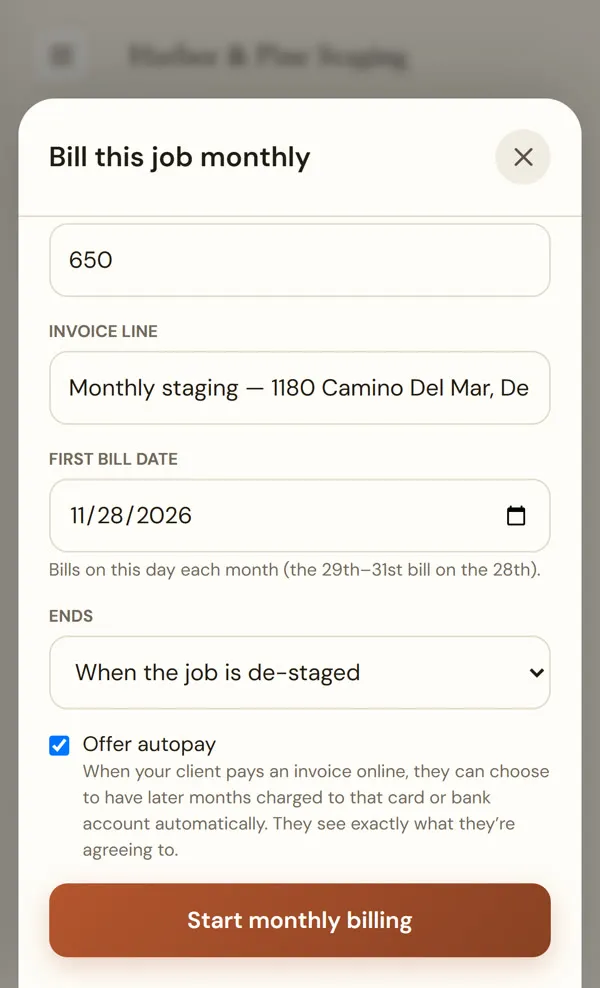
Each job carries its term and its holdover rate, as a flat amount or a percent of the staging fee. The proposal your client accepts shows what happens after the term, so the extra months are never a surprise. When the term runs out, turn on monthly billing for the job:
- An invoice is created and sent on the same day each month, with a pay link
- Clients can choose to pay future months automatically by card or bank account, saved on your own Stripe account
- Autopay clients get a heads-up email three days before each charge
- If you change the monthly amount, the client is emailed about it
- It ends at de-stage, after a set number of months, or when you stop it
- A failed charge falls back to a pay-link email, and you're told
The small rules that keep it fair
Monthly billing is forward-only. If you pause a job's billing and turn it back on, it picks up at the next bill day instead of sending three catch-up invoices at once. The de-stage day itself isn't billed as a new month. And each month is billed once: the same invoice can't go out twice, even if something retries.
All of it sits on the job, next to the contract and every other invoice, so when a client calls about month four, the whole history is on one screen.
Questions stagers ask
What is a holdover fee in home staging?
It's what the client pays when the furniture stays in the house past the term the staging fee covered, usually charged for each extra month (or each extra 30 days) until the de-stage.
Should I charge a flat amount or a percent of the staging fee?
Both are common. A flat monthly amount is simple to explain. A percent of the original staging fee scales with the size of the job. Either way, put the number in the proposal and the contract before install day.
Can the client pay the extra months automatically?
In StageEngine, yes. When a client pays an earlier invoice online they can choose to pay future months automatically. Their card or bank account is saved on your own Stripe account, each month is charged on the bill day, and they get a heads-up email three days before.
What happens when the house sells?
Set the monthly billing to end at de-stage. Once the de-stage date arrives, it stops billing, and the de-stage day itself isn't billed as a new month.
What if I pause monthly billing and turn it back on later?
It picks up at the next bill day. It never sends a pile of catch-up invoices for the months it was paused.
Stop chasing month three.
Start a free trial, add a job with its term and holdover rate, and turn on monthly billing.
Start your free trial